Karṇāṭaka Sangeeta Pravēsha
(Junior in Karnataka Style of Music)
Syllabus
General Instructions
- The syllabus outlined below represents the minimum requirements for Pravesha (Junior) Certification.
- The Pravesha curriculum is organized into four progressive levels and is designed to be completed over approximately four years at a typical pace of practice.
- The four levels represent a typical progression of learning and do not require students to appear for an examination every year or to complete the examinations sequentially.
- Students may appear directly at any level based on their preparedness. Completion of the preceding level examinations is not mandatory.
- Level 4 is mandatory for Pravesha Certification. Regardless of the level at which a student begins, Level 4 must be successfully completed to receive the Pravesha Certificate.
- The Level 4 certification examination is conducted in person at designated examination centers in the United States.
- The curriculum is cumulative. Compositions, skills, and competencies introduced at earlier levels remain part of the expected repertoire and proficiency at subsequent levels.
- Lessons and Compositions prepared at earlier levels may be carried forward and presented at subsequent-level examinations, where appropriate.
- A student appearing directly for Level 4 must demonstrate the cumulative repertoire, skills, and competencies required across Levels 1, 2, 3, and 4. Students may skip the preceding examinations, but not the curriculum requirements of those levels.
- The syllabus is common to Vocal (Gaayana) and instrumental music (Vaadya Sangeeta), including instruments such as Veena, Venu, Violin, Saxophone, Guitar, Harmonium, and Keyboard.
- Sangeeta Bharati’s curriculum is Guru- and Sampradāya-agnostic and respects diverse pedagogical traditions within Karnataka Sangeeta. Students are therefore not restricted to a prescribed list of compositions.
- Students are free to refer to appropriate learning materials and select compositions of their choice. The overall repertoire should demonstrate a well-balanced selection across rāga, tāḷa, bhāśhā, and vāggēyakāra.
Students who are not exclusively following the prescribed Sangeeta Bharati texts must submit a detailed list of the compositions prepared for the examination. For each composition, the list should include:
Composition Title, Rāga, Tāḷa, Vāggēyakāra (Composer), and Bhāśhā (Language).The repertoire list must be submitted to the examiner at least one week before the examination as a PDF by email to exams@sangeetabharati.org.
- Bhajans should be dedicated to the Gods and Goddesses worshipped in Sanatana Dharma. Students may refer to and select Bhajans from the Rana Sangeetam book.
- Nottuswara: The required Nottuswaras are available through Sangeeta Bharati’s published materials.
- Detailed curriculum content and instructional materials are available in the respective Sangeeta Bharati textbooks.
Pravesha
Prathama
(Level 1)
Optional | Mode: Virtual
Paper 1: Practical
- Swaravali (3 speeds)
- Sarale—any 7
- Janti—any 5
- Tarasthayi—any 3
- Mandrasthayi—any 3
- Datu—any 3
- Alankara—any 5
- Geetam
- Pillari Geetam—all 4
- Sanchari Geetam—any 5
- Nottuswara—any 2
- Bhajan—any 1
- Maukhika (Oral):
Knowledge of the title, rāga (including the name, ārōhaṇa and avarōhaṇa), tāḷa, vāggēyakāra, and bhāśhā of the compositions learned, and the ability to answer basic oral questions related to them.
Students may use Sangeeta Bharati’s book – Sangeeta Pravesha Prathama
Pravesha
Dwiteeya
(Level 2)
Optional | Mode: Virtual
Paper 1: Practical
- Swaravali (3 speeds)
- Sarale—any 7
- Janti—any 5
- Tarasthayi—any 3
- Mandrasthayi—any 3
- Datu—any 3
- Alankara—all 7
- Geetam
- Pillari Geetam—all 4
- Sanchari Geetam—any 5
- Swarajati and Jatiswara—any 2 each (total 4)
- Tana Varna—any 2 in two speeds
- Madhyamakala Kruti—any 2
- Nottuswara—any 3
- Bhajan—any 2
Paper 2: Maukhika (Oral)
Knowledge of the title, rāga (including the name, ārōhaṇa, avarōhaṇa, and rāga-lakśhaṇa), tāḷa, vāggēyakāra, and bhāśhā of the compositions learned, and the ability to answer basic oral questions related to them.
Paper 3: Theory
Students may use Sangeeta Bharati’s book – Sangeeta Pravesha Dwiteeya
Pravesha
Truteeya
(Level 3)
Optional | Mode: Virtual
Paper 1: Practical
- Swaravali (3 speeds)
- Sarale—any 7
- Janti—any 5
- Tarasthayi—any 3
- Mandrasthayi—any 3
- Datu—any 3
- Alankara—all 7
- Geetam
- Pillari Geetam—all 4
- Sanchari Geetam—any 5
- Swarajati and Jatiswara—any 2 each (total 4)
- Tana Varna—any 3 in two speeds
- Madhyamakala Kruti—any 5
- Vilambakala Kruti—any 1
- Nottuswara—any 5
- Vachana—any 2
- Bhajan—any 3
Paper 2: Maukhika (Oral)
Knowledge of the title, rāga (including the name, ārōhaṇa, avarōhaṇa, rāga-lakśhaṇa, and rāga identification), tāḷa, vāggēyakāra, bhāśhā, and gist of the compositions learned, and the ability to answer basic oral questions related to them.
Paper 3: Theory
Students may use Sangeeta Bharati’s book – Sangeeta Pravesha Truteeya
Pravesha
Chaturtha
(Level 4)
Mandatory | In-person
Paper 1: Practical
- Swaravali (3 speeds)
- Sarale—any 7
- Janti—any 5
- Tarasthayi—any 3
- Mandrasthayi—any 3
- Datu—any 3
- Alankara—all 7
- Geetam
- Pillari Geetam—all 4
- Sanchari Geetam—any 5
- Lakshana Geetam—any 2
- Swarajati and Jatiswara—any 2 each (total 4)
- Tana Varnas—any 4 in two speeds
- Madhyamakala Kruti—any 8
- Vilambakala Kruti—any 3
- Keertana—any 2
- Nottuswara—any 5
- Vachana—any 2
- Bhajan—any 4
Paper 2: Maukhika (Oral)
Knowledge of the title, rāga (including the name, ārōhaṇa, avarōhaṇa, and rāga-lakśhaṇa), tāḷa, vāggēyakāra, bhāśhā, and gist of the compositions learned, and the ability to answer basic oral questions related to them.
Paper 3: Shravana and Sangeeta Lipi Jnana
(Aural and Notation Skills)
Paper 4: Theory
Common Theory
Kala Shastra Pravesha—Parts 1 & 2
And Karnataka Sangeeta Theory Sangeeta Pravesha
Mode: Written
Students may use Sangeeta Bharati’s book – Sangeeta Pravesha Chaturtha
Karṇāṭaka Sangeeta Madhyama
(Senior in Karnataka Classical Music)
Work in progress. For now, one can access the available materials from the link
https://drive.google.com/drive/u/1/folders/1zsNVryJQ0pqEVdLYqibCwYXyiy-dCBTY.
Textbooks
Juniors Karnataka Sangeeta Learning
An abridged version in Kannada
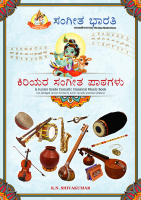
Juniors Karnataka Sangeeta Learning – An abridged version is a concise junior’s Karnataka Sangeeta book in Kannada. This book is compiled in accordance with the practical syllabus prescribed by the Karnataka Secondary Education Examination Board (KSEEB) for the juniors music examination. Unlike other Sangeeta Bharati books which are designed for Letter size printing, this book is designed for printing on A4 size papers, a common paper size used in Bharat.
Sangeeta Pravesha Practicals
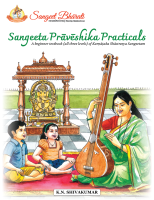
This book, termed an encyclopedia of Karnataka Sangeeta, has everything needed for the practical examination at all three levels of Sangeeta Pravesha (Karnataka Sangeeta Junior).
The download of this book is disabled while we prepare its revised version.
Sangeeta Pravesha Theory and Examination Manual
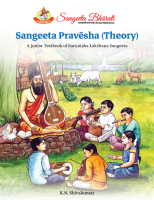
This book contains the theory (shastra or lakshana) of Karnataka Shastreeya Sangeeta, which a junior-level student should be familiar with. The book has both elements and principles of music to prepare for the written music examination.
The book also has information about the examination, syllabus, sample question papers, evaluation criteria, and much more for Pravesha and its sub-levels.
Video Lessons